


Why Do Kids Sometimes Outgrow Food Allergies?
Learn how cells and bacteria in the gut affect food allergies.
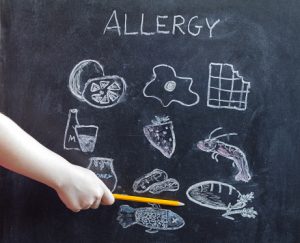
Roughly 15 million Americans—the majority of them children—have food allergies. Have you ever wondered why this is? Or why many kids can actually outgrow their food allergies as they mature?
The answer has to do with how our immune systems learn to differentiate between dangerous and benign foreign substances.
Just like pathogens, food contains macromolecular markers known as antigens, which the immune system recognizes as foreign. Of course, if our immune system thought all food was a foe, life would be impossible. Fortunately, the gut can produce various T-regulatory or “Treg” cells in order to suppress the immune response to specific food proteins.
In a recently published study, researchers took a closer look at the Treg development process to see if consuming new foods stimulated the production of new Tregs. The researchers compared two populations of mice, one that had been raised and fed normally, and one that had been raised in a germ-free environment and fed an elemental diet consisting of amino acids rather than intact proteins. Because amino acids are too small to be recognized by the immune system, the mice in this second group had had no prior contact with antigens of any kind.
Testing revealed that the mice in the second group had virtually no Tregs, while the mice in the first group had distinct populations of Tregs generated by exposure to food and by contact with beneficial bacteria in the gut.
When the second group of mice were fed a new protein for the first time, they mounted a massive immune reaction. This is similar to what might occur the first time a child is exposed to one of the most common food allergens like milk, eggs, wheat, soy, peanuts, tree nuts, shellfish, and fish. If the child does not have correlated Tregs from beneficial bacteria in the gut, they may have an allergic reaction. But with time and a varied diet, they could develop their own Tregs, which would reduce or eliminate their immune response.
Now You May Wonder…
…How Can I Tell If a Child Will Tolerate a Food They Have Previously Had a Reaction To?
Because some children may have very serious reactions to certain food allergens, it is not wise to have them eat these foods in the hopes of making them develop relevant Tregs, or to test if they have already developed helpful Tregs through exposure to other foods and bacteria.
What you can do is get periodic food allergy testing for your child from a qualified allergy doctor. Your doctor can advise you if it is ever appropriate to begin introducing foods your child showed an allergic reaction to when younger.
If you would like to talk to a qualified allergy doctor about your child’s food allergies, please contact Allergy, Asthma, & Immunology Medical Group today and make an appointment.




Special Pricing on Air Purifiers Through Molekule Partnership
We have teamed up with Molekule, a leading brand in air purifiers, to provide our patients exclusive discounted pricing on their air purifiers. Access our dedicated link to view these special rates.
The discounted price will be clearly visible during the checkout process, before entering your credit card information. This way, you'll know exactly how much you're saving before finalizing your purchase.
Click hereCopyright © 2026 Allergy, Asthma, and Immunology Medical Group.
All Rights Reserved.
451 W. Gonzales Rd, Suite 150, Oxnard, CA 93030 | 805-658-9500
23928 Lyons Avenue, Suite 208, Newhall, CA 91321 | 805-658-9500
3801 Las Posas Road, Suite 211, Camarillo, CA 93010 | 805-658-9500
